



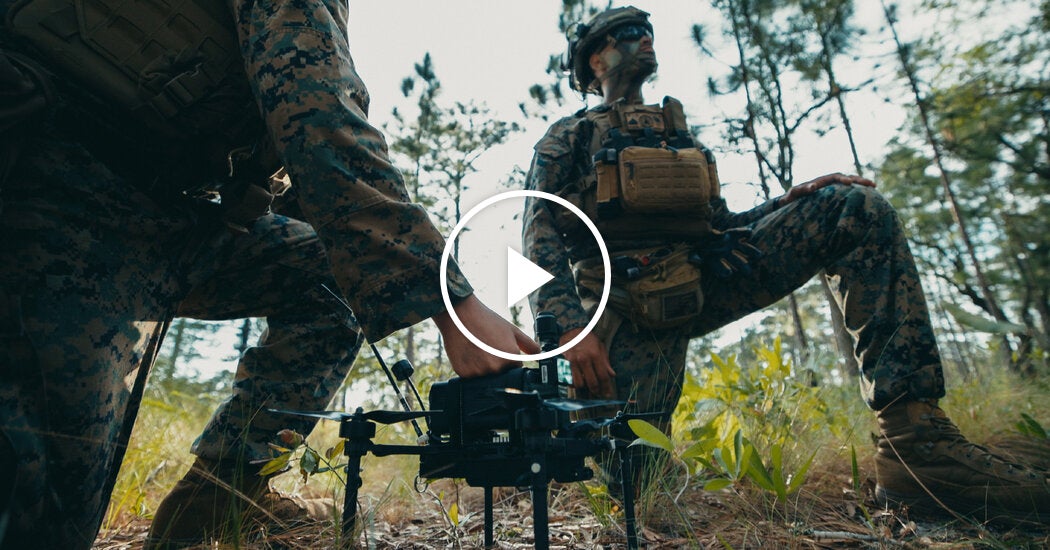
“Drop a bomb on target. 1 APRS. HOB 4 meters. SST 32 seconds.'' “Roger sends.'' It's a small weapon seen in conflicts around the world. “Attach the warhead. Insert the cap.” “Inverted Drone.” “Turn the prop.” You may not see it coming, but you can hear it. And by then it's already too late. “Contact me. I've got a south-east facing window. Request permission to engage.” So this is a first-person attack drone, essentially a modified quadcopter. And these Marines just went through three weeks of training to get this ready to go into combat. FPV is designed to track moving targets and bomb them with the push of a button. This seemingly simple technology has transformed and even defined modern warfare. “The hostile drone threat we face today grows every day.” Last summer, Secretary of Defense Pete Hegseth ordered combatant forces across the military to rapidly train and deploy smaller, more lethal drones like those seen in Ukraine and the Middle East. Currently, the Marine Corps is rushing to train and certify hundreds of pilots and introduce FPV drones to all units. This will be the first time the Marine Corps has attack drone capabilities. “This course was the first time I touched and operated an FPV drone, and I had no prior experience with it,” said Corporal Noah Player, a member of the 24th Marine Expeditionary Unit. He and his fellow Marines could be deployed at any time and would be expected to use such drones in combat. “This is the generation of video games where you have a controller in your hand and a headset in your eye.” The pilot sees exactly what the drone is seeing through the headset and uses the controller to guide the drone to its target. “But I think the most heart-wrenching feeling for me is being able to see faces and people before they hit me with FPV. Yes, it's scary.” “If I don't kill people with this, they'll do the same to my sons.” Unlike America's Gray Eagle and Reaper drones, which are the size of a school bus and cost millions of dollars to manufacture, FPV is small, cheap, and highly accurate. “If we were to get into the air in a small flying plane, all we could do was look at things: intelligence, surveillance, reconnaissance. What we didn't have were kinetic assets, and we didn't have assets so cheap that we didn't have to recover them.” Russia and Iran have been refining this technology in combat for years. Now, Marines like Noah are expected to master these abilities in a matter of weeks. “We want to make sure that the way we implement and use FPV drones is the most effective, so we think that makes us a deadly competitor.” “Are we moving fast enough? No. But I don't think we'll ever be able to move fast enough. What we're doing now is taking steps to make sure that when we encounter an enemy on the battlefield, we can employ better systems and be able to shoot, move and communicate better than the enemy. China and Russia have the capacity to produce millions of FPV drones annually. By comparison, the Pentagon's goal is to have tens of thousands of aircraft in place by the end of 2026. “Will it be enough to fight the millions of aircraft our potential adversary has?” “Even if you gave the Marine Corps millions of drones, all but a few thousand drones would be sitting on a shelf somewhere because there aren't enough Marines to deploy them. More importantly, the drones aren't employed. “How do we replenish the number of drones we have to fight against them?” The Pentagon has acknowledged for years that it needs to take drone warfare more seriously, but only recently has it begun to tackle it on a large scale. “If you were to deploy tomorrow, how can you be sure that you would be ready for the mission and that you would be able to meet the challenges?'' “Experience is experience, and you can't take away experience. But I think with the little time we have and the amount of effort and determination we have, we can go head-to-head.''
Trending
- President Trump overcomes Spain bashing to award World Cup trophy to his country team
- Democrats vie for desperately needed House seats in Arizona primary
- Nolan's 'The Odyssey' grosses $124.5 million in opening weekend
- The United States geared up for the World Cup. I fell in love instead.
- Step into the “genius zone” (before AI takes your job)
- Trump slams 'sanctuary' states, but many still support deportations
- Catholic holy sites where President Trump wants to build border wall
- What we learned about Jeffrey Epstein's death
