



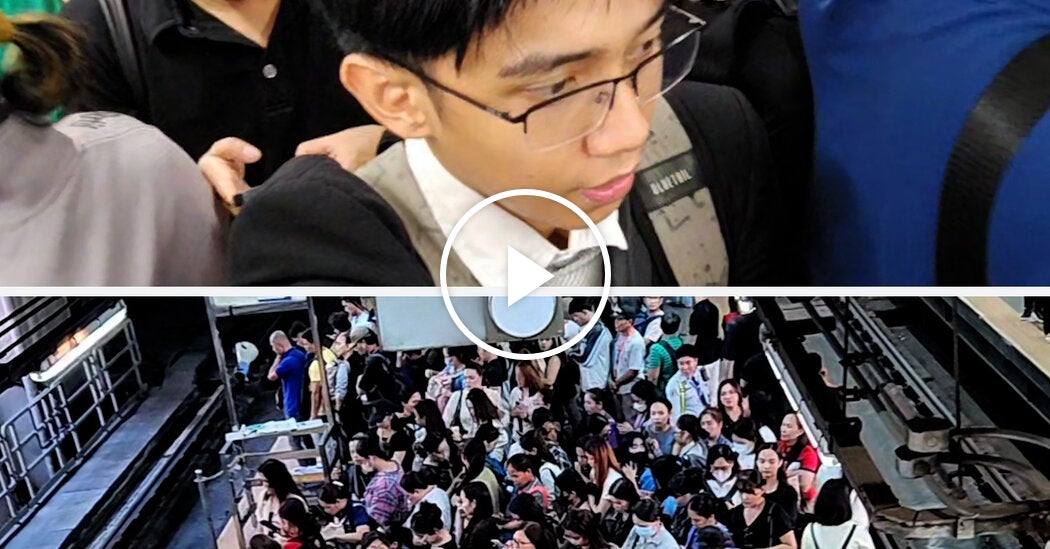
Commuting in the Philippines is very chaotic. “When you get on the train, you have to protect yourself from being squeezed.” “We call this a sardine situation. It's becoming an unimaginable situation.” The Iran war triggered a global energy crisis, and pump prices in the Philippines more than doubled. As a result, people are forced to forego cars and rely on public transport, such as trains and common vehicles called jeepneys, which typically seat around 20 people. Many people are wondering how to navigate the rush hour crowds while still saving money. “Excuse me.” These commuters filmed their new and challenging journey and posted it on social media. “I stopped driving. I take public transportation to work.” Stella Kim works as a project coordinator at a multinational company in Manila. She typically drove about an hour and a half to work. But then gas prices started rising. “It wasn't worth it. It was very expensive.” So Kim now calls for a motorbike and commutes by train and jeepney. “I used to ride a jeepney about once a month, but now it seems like the cheapest option.” Kim said the new commute costs half the cost of driving, but adds an hour and a half to her travel time. “I got home at 9:30 p.m., so just going home is the end of the day.'' The influx of new passengers has made travel difficult for commuters like Steven Emperado. “This makes lines longer, waiting times less predictable, and competition for space.'' He was already having trouble commuting to his university in Manila. “First, you take a jeepney to the MRT station and then transfer to another train,” Emperado said, adding that the rush hour crowds are stressful. “It's quite taxing physically and of course mentally,” he said, before commuting was his only free time for reading and studying. “On my way to work, all I can do is take a book with me, and I can't even open it.'' He also takes extra shirts with him, as his body collapses in the summer heat. So Emperado found a way to get around rush hour. “I want to avoid crowds, so I sometimes stay at a friend's apartment near school, or come home around 9 or 10 p.m.'' To get her life back together, Kim started looking for a condo near her office. “Living closer to the city will allow me to do other things. I'll be closer to my co-workers. I'll be able to hang out more often.” Both Kim and Emperado are eager for things to return to normal. “We just hope that this energy, fuel crisis subsides.” “Filipinos are a very resilient people. Despite the fuel crisis, we are really doing our best.”
Trending
- President Trump overcomes Spain bashing to award World Cup trophy to his country team
- Democrats vie for desperately needed House seats in Arizona primary
- Nolan's 'The Odyssey' grosses $124.5 million in opening weekend
- The United States geared up for the World Cup. I fell in love instead.
- Step into the “genius zone” (before AI takes your job)
- Trump slams 'sanctuary' states, but many still support deportations
- Catholic holy sites where President Trump wants to build border wall
- What we learned about Jeffrey Epstein's death
