



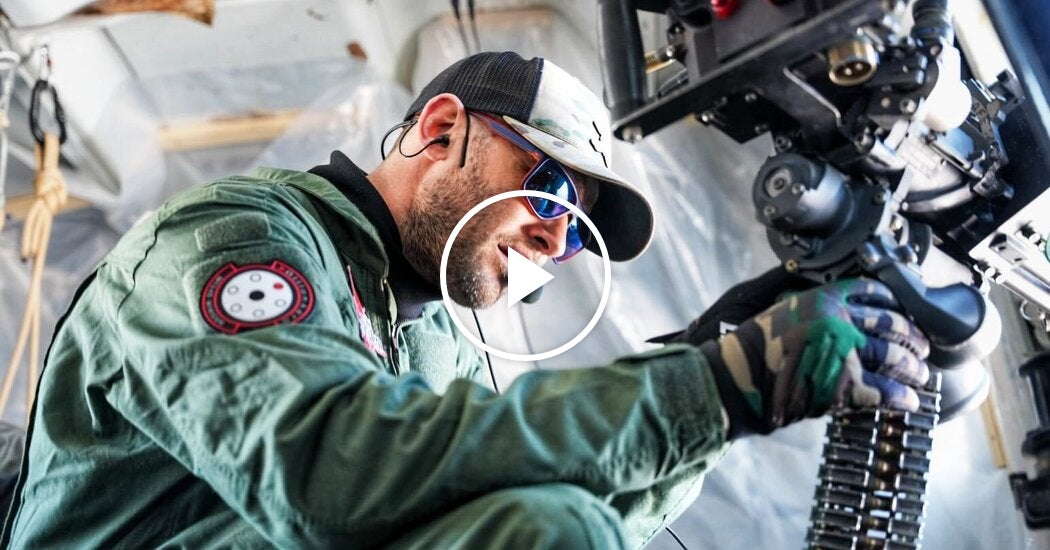
Inside this old skydiving plane, a crew of Ukrainian volunteers tracks a Russian drone. Russia sends thousands of one-way attack drones into Ukraine every month. Many were shot down, but the country's air defenses cannot stop them all. Mounted on the sides of the fuselage here is an American machine gun capable of firing up to 3,000 rounds per minute, or 50 rounds per second. And they are shooting down drones one after another. The ammunition needed to shoot down a single drone costs about $500, a bargain considering the Iranian-designed Shahed drones are mass-produced in the tens of thousands each and the surface-to-air missiles to counter them could number in the millions. This is a cost-effective way to combat the new threats of modern warfare. “And here it comes. Someone is sitting here.'' “Yeah.'' “And here comes the piece.'' Valerie Slipkan lived on this remote airstrip for nine months, waiting for a mission. After losing his son in the first days of a full-scale invasion, he moved into a trailer on the landing field and began converting this old skydiving plane for war use. Since mid-2025, Ukraine has allowed and even encouraged civilians exempt from military service to fight drones. Valerie is the only member of the crew with combat experience. They are all volunteers but take orders from Ukraine's air defense coordinator. Waiting long hours for a mission in a safe house near the airfield strengthened their bond as a team. Drones are not only Ukraine's deadliest weapon, they are also redefining modern warfare. This year, Iran sent waves of drones across the Middle East in response to attacks by Israel and the United States. Once considered a safe haven, the glitzy Gulf cities suddenly woke up to the threat of cheap but effective drones. Countries are now looking to Ukraine for expertise. From interceptors to armed helicopter units, the anti-drone weapons built out of necessity are among the most effective in the world. “So these are the markings of all the drones you shot down?” “Oh, there's actually this comma too. So you can see how much we did in one flight. Valerie's co-pilot is a world champion aerobatic who once won millions performing seemingly impossible stunts. Timur They're now piloting this Soviet-era AN-28, which was used as a civilian skydiving aircraft before the Russian invasion.“This is the door gunner.''The number of drones they have shot down is still a drop in the bucket compared to the tens of thousands of aircraft launched by Russia. But Timur sees the experimental unit as a blueprint on which Ukraine can expand. He is building his own fleet of drone fighters to prove that the human touch is still needed to kill machines. The father of five children is also exempt from military service. But he sold the business and poured the winnings into the project. “You said it's important to shoot these things down over unpopulated areas.'' “That's the law for us. Sometimes you have to be with them for five or seven minutes. If you fly over populated areas, you can shoot them down.'' “If you had to point a weapon at a human, would you do this job?'' “Well, I definitely prefer killing machines.'' It's 1 a.m. Your team will receive an alert. Drones were launched across Ukraine. They rush to the runway and prepare the plane for takeoff. Then they are told to wait. “And either it's ordered to take off and do its job, or we're waiting for orders.” So some nights might be like this. Anything that appears on the radar can be lost. Or you're told to “stand back” over and over again. they have to do this. We are available 24 hours a day, 365 days a year. “I always tell myself that's a good thing. We're not flying, which means there's no big attacks. It's tiring, but that's part of the job.”
Trending
- President Trump overcomes Spain bashing to award World Cup trophy to his country team
- Democrats vie for desperately needed House seats in Arizona primary
- Nolan's 'The Odyssey' grosses $124.5 million in opening weekend
- The United States geared up for the World Cup. I fell in love instead.
- Step into the “genius zone” (before AI takes your job)
- Trump slams 'sanctuary' states, but many still support deportations
- Catholic holy sites where President Trump wants to build border wall
- What we learned about Jeffrey Epstein's death
