



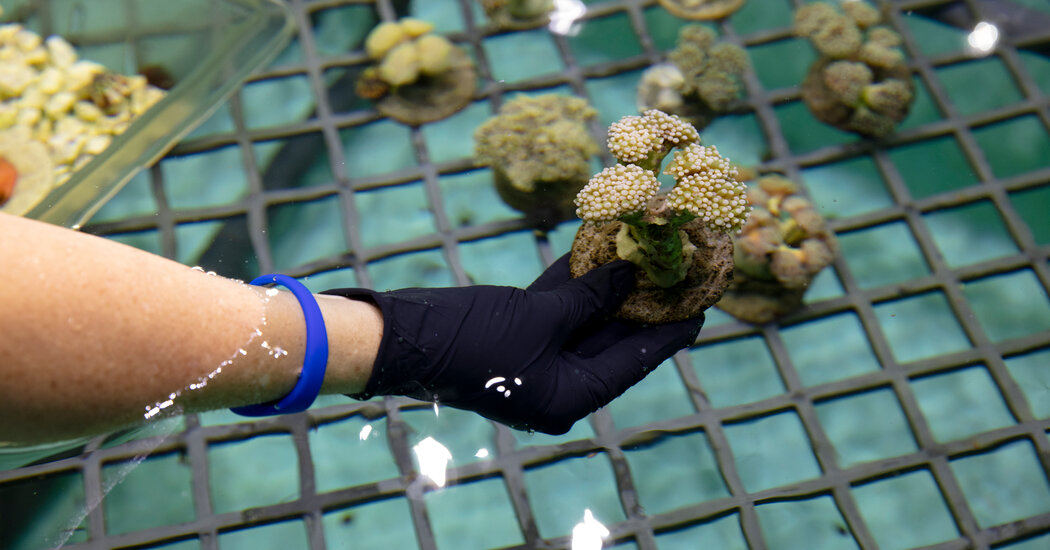
When federal wildlife inspectors search illegally traded animal goods, one might imagine they're looking for elephant tusks or tiger skins, but other creatures that you might not realize are animals are also frequently seized at US ports of entry: coral.
Corals are not plants. They are tiny invertebrates that live in vast colonies and form the foundation of tropical reefs around the world. Marine life traffickers use hammers and chisels to chip away at corals from reefs in Indonesia, Fiji, Tonga, Australia, the Caribbean and elsewhere, pack them into small bags of seawater, box them up by the hundreds, and ship them around the world. While most corals are transported to the United States legally, an increasing number of individuals and wholesalers are having restricted or prohibited coral species and quantities seized for concealing them in shipments containing legal species.
All over the world, corals, which live on reefs, filter the water and provide habitat for many fish and other marine life, are under threat. They face disease outbreaks, bleaching, ocean acidification and rising sea temperatures. Their plight is exacerbated by human activities on land that cause sediment and nutrient runoff, cyanide fishing practices and even trampling by tourists.
And if the corals remain healthy and undisturbed, they may become targets for traffickers, who sell them to aquarium hobbyists in wealthy countries, who may or may not know that the corals were obtained illegally. Between 1999 and 2018, corals were the third most seized wildlife group in the world, accounting for 14.6 percent of all corals seized, according to a report by the United Nations Office on Drugs and Crime. The United States accounts for a large portion of this trade.
“The United States is the leading market for marine coral,” says Ashley Skeen, a senior wildlife inspector for the U.S. Fish and Wildlife Service. “We're number one.”
According to NOAA Fisheries, more than 25 species of coral are considered endangered or threatened under the Endangered Species Act and are protected by federal law. Internationally, the Convention on International Trade in Endangered Species of Wild Fauna and Flora regulates trade in approximately 1,900 species of coral, including black coral, red coral, pink coral, blue coral, stony coral, organ pipe coral, and fire coral.
To make matters worse, by the time these animals reach American shores, they are often diseased.
“When corals are stressed, they often develop a thicker layer of mucus to protect themselves,” says Kim Stone, head of fish and invertebrates at the Georgia Aquarium in Atlanta, which has helped federal wildlife officials save the seized corals.
This supposedly protective measure pollutes the reef's tiny reservoir of water, changing pH and oxygen levels, which in turn further stress the animals, creating what Stone calls a “vicious cycle.” It is not uncommon for shipments of coral to contain animals that are already dead.
“If the water isn't clear, you need to move quickly,” Stone said.
As wildlife officials try to reduce demand and cut off the supply of illegal coral, they face a major dilemma: what to do with the endangered animals they catch.
The seized animals must be contained and cared for, not only for their own welfare, but also because, once seized, they serve as evidence. That means they must be cared for until the charges against the trafficking defendants are dropped or the animals are permanently seized by the authorities. And even then, it is usually not possible to release the corals back into the wild, either because the origins of the animals are unclear or because the countries where they were taken will not take them.
To address the problem, the U.S. Fish and Wildlife Service works with zoos and aquariums near airports and ports to protect corals on a case-by-case basis, but the closest facilities are often in high-traffic areas and end up flooded.
In 2023, the department is launching a pilot program in Southern California in collaboration with the Association of Zoos and Aquariums to help solve that problem by creating an equivalent of the Bat Signal for confiscated wildlife. It's called the Wildlife Confiscated Network, and it's been so successful that officials are now working to replicate the effort in the Southeast.
“We've built a network of trusted, reputable facilities,” says Sarah Walker, senior adviser on wildlife trafficking at the Association of Zoos and Aquariums, “so law enforcement can contact one person who will do all the homework, make the calls and find out who has space.”
This is important when large numbers of animals are being transported that may require triage and housing provision across different organisations, and all of this needs to be done quickly.
In fact, some corals cannot be identified when they are in danger because the individual, or polyp, does not open. To get the corals out, Stone says it is important to acclimate them to clean running water and eventually to the right food. Depending on the type and condition of the coral, you may also need to adjust the light intensity.
The Wildlife Seizure Network currently includes 26 facilities, many of which are concentrated in Southern California, including the San Diego Zoo, the Los Angeles Zoo and Botanical Gardens and the Living Desert Zoo and Botanical Gardens in Palm Springs.
Each agency is vetted and trained on how to triage corals and other seized animals, and how to do so in a way that does not jeopardize the public investigation: for example, seized animals are rigorously logged, kept out of sight, and not discussed with the public or the press until the investigation is complete.
Since its launch in August 2023, the Wildlife Seizure Network has already disposed of approximately 2,800 animals as part of more than 70 legal cases.
“A lot of it is aquatic invertebrates,” Walker says, “including hundreds of corals and shellfish.”
In April, officials from the Fish and Wildlife Service and the Association of Zoos and Aquariums met with the Georgia Aquarium and more than a dozen animal shelters to discuss expanding the network into the Southeast, with the goal of more evenly addressing the flow of illegal invertebrates into the region.
Officials say the Georgia Aquarium is a natural partner in the effort. Huge seizures have taken place at Hartsfield-Jackson Atlanta International Airport, and the Georgia Aquarium has taken in about 1,000 of the animals seized since 2010. In addition to the tonnes of coral, animals that have fallen victim to smuggling include motoray rays, sharks, stingrays, sea turtles and seahorses. But nearly half the animals are coral, Stone said.
While final details are still being worked out, expanding the network across the Southeast could help ease pressure on both government agencies and animal shelters, and potentially even include facilities in Florida and Texas.
While experts say corals are better left in the wild, there is a positive side to this, as illegally traded specimens are often seized and properly managed by experts. In fact, if you've ever visited an aquarium, there's a good chance you've seen some of the corals that have been seized.
For example, walking through the Georgia Aquarium's Indo-Pacific Barrier Reef exhibit, you can see turbinaria corals that were confiscated in 2005, shortly after Stone joined the aquarium.
It took years for the turbinaria to recover, but now under her care the colony has grown to over 2.5 feet in height and is shaped like a giant eye.
