



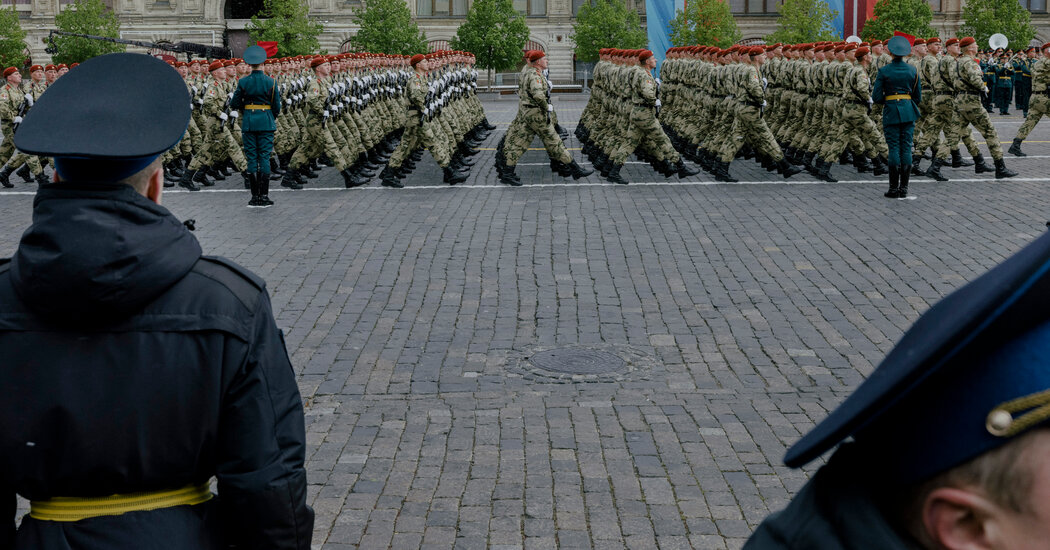
Periodic protests over incompetence and corruption in the Russian military's top brass have dogged President Vladimir V. Putin's war effort since the start of his invasion of Ukraine in early 2022.
When Putin's forces weakened around the Ukrainian capital, Kiev, the need for reform became apparent. A few months later, their retreat outside the city of Kharkiv raised hopes of renewal. Then, when mercenary leader Yevgeny V. Prigozhin led his men toward Moscow, complaining of deep corruption and incompetence in the Russian military's upper echelons, Putin seemed compelled to respond.
But at each occasion the Russian president avoided any major public actions that could be seen as justifying the criticism, instead keeping the defense minister and commander in chief in place amid intense criticism while replacing battlefield commanders and making other appointments to lower-ranking officials.
Now that the danger of the battlefield had passed and Prigozhin was dead, Russia's leader decided to act, replacing the defense minister for the first time in more than a decade and authorizing several arrests of senior ministry officials on corruption charges.
The moves heralded the biggest shakeup of the Russian Defense Ministry since the start of the invasion and underscored Putin's preference for acting at low-key moments of his own choosing rather than taking major steps in the middle of a crisis.
“You need to understand that Putin is a stubborn, inflexible person,” said Abbas Gallyamov, a former Putin speechwriter who now lives outside Russia. “He thinks that reacting too hastily to changing circumstances is a sign of weakness.”
Experts say the timing of Putin's latest actions likely reflect growing confidence in his prospects on the battlefield in Ukraine and his ability to maintain political power as he begins his fifth term as president.
Ukraine has been plagued by slow aid from the United States and shortages of ammunition and personnel, but Russian forces have been gaining ground in Ukraine, seizing territory around Kharkiv and in the Donbas region, and senior Kremlin officials are optimistic.
“They likely judge the situation within the military to be stable enough to punish parts of the military leadership for earlier failures,” said Michael Kofman, an expert on the Russian military and senior fellow at the Carnegie Endowment for International Peace.
Calls for change within the Russian military ranks had been growing since the beginning of the invasion, when rumors circulated that Russian soldiers had gone to war without adequate food or equipment, and that they were losing their lives following the orders of irresponsible military leaders.
The anger culminated in an attempted uprising led by Mr Prigozhin last year, who was subsequently killed in a plane crash that US authorities say was likely a state-sanctioned assassination.
Mr. Prigozhin, a caterer-turned-warlord who made his fortune off state contracts, was an unlikely evangelist. But his expletive-laced tirades against then-Defense Minister Sergei K. Shoigu and General Valery V. Gerasimov, the Russian military's top commander, painted a picture of high-level corruption among Russian rank and file soldiers and the broader public. At one point, Mr. Prigozhin photographed himself in front of a pile of dead Russian soldiers and criticized officials for being “covered in fat” in their wood-paneled offices.
The failure of the subsequent putsch showed that problems at the defence ministry that had been simmering for more than a decade under Shoigu had come to a head and that the public was desperate for renewal, said a person close to the ministry, speaking on condition of anonymity to discuss the sensitive issue.
The Russian leader now appears to be turning his attack on the very officials that Prigozhin was attacking.
The first sign of change came last month with the arrest of Mr. Shoigu's lover, Timur Ivanov, a deputy defense minister in charge of military construction projects, who Russian authorities accuse of accepting hundreds of millions of bribes. He denies wrongdoing. Mr. Ivanov had previously attracted the attention of Alexei A. Navalny's anti-corruption foundation for the ostentatious, lavish lifestyle he and his wife led, which included renting a yacht on the French Riviera.
Then this month, days after Mr. Putin began his new term as president, the Kremlin announced it had replaced Mr. Shoigu with one of his longtime economic advisers, Andrei R. Belousov, as the new defense minister. Mr. Shoigu was named chairman of Russia's Security Council and will retain access to the president but will have little direct control over finances.
“If you want to win a war, you don't want, at least in theory, large-scale corruption that would affect outcomes on the battlefield,” said Maria Engqvist, deputy director of Russian and Eurasian studies at the Swedish Defence Research Agency.
Still, Engvist said high-level corruption in Russia is “a feature, not a flaw.”
“Corruption is a way to gain influence, but if you say the wrong thing at the wrong time or make the wrong decision at the wrong time, it can always work against you,” she said. “So if you have a reasonable explanation that the public can accept, you can be ousted.”
Engqvist said the personnel changes also raised questions about how long General Gerasimov would remain in his position as Ukraine's chief of staff and top battlefield commander.
Arrests at the Defense Ministry accelerated this month, detaining four more senior officials and defense officials on corruption charges. Kremlin spokesman Dmitry S. Peskov on Thursday denied that the arrests were the result of a “campaign.”
The corruption charges against senior defence ministry officials come alongside promises of increased financial and social benefits for soldiers in a move seen as an attempt to boost morale and assuage populist criticism.
In his first remarks since being named defense minister, Belousov outlined plans to cut bureaucracy and improve access to health care and other social services for war veterans. Also on Thursday, Vyacheslav V. Volodin, speaker of the Russian Duma, and Finance Minister Anton G. Siluanov expressed support for exempting Ukrainian combatants from a proposed income tax increase.
Dara Massicot, a senior fellow at the Carnegie Endowment for International Peace, said the arrests are unlikely to root out widespread corruption within the Russian military, but they could make officials think twice, at least for a while, before committing theft, especially on such a large scale.
“This measure will have a chilling effect on the system and give everyone pause to understand the new norms of acceptable behavior,” Massicotte said.
At least one arrest appears to have been aimed at settling a political score as well as sending an anti-corruption message.
Maj. Gen. Ivan Popov, Russia's top military commander who led forces fighting back against a Ukrainian counterattack, rebuked Russia's military leadership in a widely publicized recording after he was fired last year. Popov was arrested on fraud charges on Tuesday, according to state news agency TASS. His lawyer said he denies any wrongdoing.
“Ultimately, the war has exposed a lot of different problems that the leadership feels need to address — corruption, incompetence, open displays of insubordination,” said Samuel Sharap, a senior political scientist at the RAND Corporation. “The absence of serious near-term risks on the battlefield makes it the right time to address them.”
