



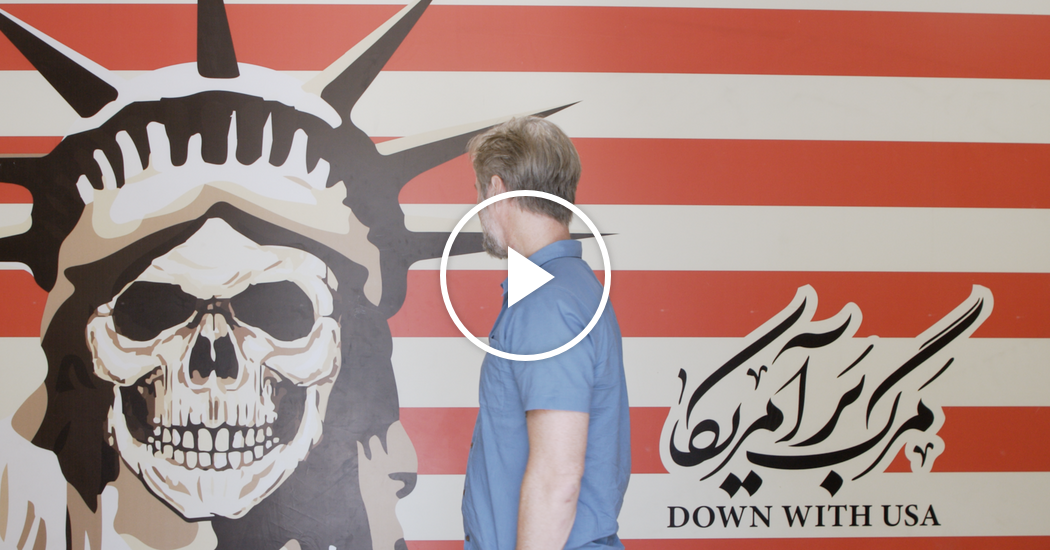
So we are outside the US Embassy in Tehran. There is an apple with the CNN logo on it. Twin towers dotted with dollar signs. statue of liberty. This is probably one of the most photographed walls in all of Tehran. Americans know this as the former U.S. compound. But to Iranians, it is known as the “US Spy Den Museum.” And, of course, what happened here is the root of more than 40 years of hostility between the United States and Iran, which has recently escalated. In June, Israel and the United States launched attacks on Iran, resulting in a brief but intense war that shook the capital and left hundreds dead. Foreign journalists are restricted in Iran, but during a recent trip, officials allowed us to visit the former embassy where much of the current hostility stems from. On November 4, 1979, Iranian students stormed the embassy, fearing that the United States was planning to reinstate the Shah, who had been ousted months earlier. They held 52 people hostage for a total of 444 days. [Voiceover] “The students had limited outside contact with the hostages. So far, they had refused to forward letters to the prisoners.” “How can you call these hostages? These people are political smugglers.” “I have announced a series of economic and political actions.” “We are past the time for gestures. We want our people to be freed.'' Six CIA officers were among the hostages, the US government later announced, accusing Iran of violating diplomatic protocol. Decades of tension will continue. “So this was during the hostage situation?'' “After the hostage situation.'' “After the students came in.'' Amir, 21, works as a guide here as part of his military service. Like many people in Iran, where self-censorship is common, he asked us not to use his last name. “How many people usually visit this museum each year?'' “About 5,000 people, mostly from Asia, but occasionally from the United States and the United Kingdom.'' This is the office of a former U.S. ambassador. It has been carefully preserved to look almost exactly as it did before the hostage crisis. When it became certain that students were occupying the embassy, the Americans inside desperately tried to shred as many classified documents as possible. “These are the famous shredding machines that most Americans probably know from the movie Argo, right?'' “Students tried to recover some of these documents. It took six years to reassemble the shredded paper. And after recovery, the students categorized all these documents as one book.'' This part of the museum has a particular focus and is represented as a CIA station. It's full of spy equipment. There are encryption devices and eavesdropping devices. There's a safe room right behind me. And for the regime here, it is presented as evidence that this building was not only used for diplomacy, but also to keep an eye on the Iranians and, as they see it, interfere in their affairs. “This is all we have to eavesdrop on communications and monitor communications.'' “Yes, I have to say, this is more sophisticated than I imagined. It gives us an idea of what espionage was like almost 50 years ago.'' The museum's message was clear to visitors, including the few foreign journalists like us who were allowed in. Americans couldn't be trusted then, and they shouldn't be trusted now. Many Iranians, who see the museum as a relic of a distant past, told me they had been on high alert since the June war, fearing hostilities with the United States could break out at any moment. It is a reminder that this troubled history still resonates today.
Trending
- President Trump overcomes Spain bashing to award World Cup trophy to his country team
- Democrats vie for desperately needed House seats in Arizona primary
- Nolan's 'The Odyssey' grosses $124.5 million in opening weekend
- The United States geared up for the World Cup. I fell in love instead.
- Step into the “genius zone” (before AI takes your job)
- Trump slams 'sanctuary' states, but many still support deportations
- Catholic holy sites where President Trump wants to build border wall
- What we learned about Jeffrey Epstein's death
