



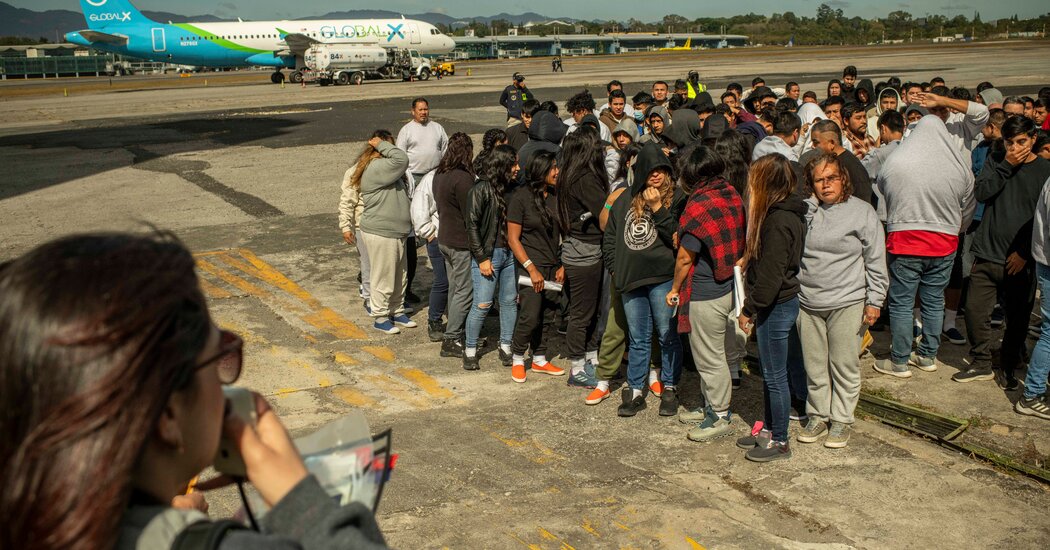
Carlos Navarro said he was recently arrested by immigration officials while eating takeout outside a restaurant in Virginia and was issued a deportation order.
Navarro, 32, said he had never been in trouble with the law, adding that he worked at a poultry factory.
“Absolutely nothing.”
Last week, he returned to Guatemala for the first time in 11 years, calling his wife in the United States from a deportee reception center in the capital, Guatemala City.
Mr. Navarro's experience could be a precursor to the kind of expedited deportations under President Donald J. Trump for communities across the United States that are home to 14 million illegal immigrants. .
The administration, which is promising the largest deportation in American history, is said to begin deporting people as early as Tuesday. In his inaugural address on Monday, Trump promised to “begin the process of bringing millions of criminal aliens back to their homes.”
Mr. Navarro's situation offers a glimpse into what mass deportation means for Latin American countries on the other side of the deportation pipeline.
Local authorities are preparing to take in significant numbers of people, but many governments say they have been unable to meet with the incoming administration about pursuing deportations.
Guatemala is a small, impoverished country scarred by a brutal civil war, but the United States has a significant number of undocumented immigrants. According to the Pew Research Center, there were approximately 675,000 undocumented Guatemalans living in the country in 2022.
That makes it one of the largest sources of illegal immigrants in the United States, after Mexico, India and El Salvador, and a testing ground for how mass deportation changes life outside the United States.
Guatemala received about seven deportation flights a week from the United States last year, representing about 1,000 people, immigration officials said. The government has told U.S. officials that such flights could be operated up to 20 times a week, or about 2,500 people, the officials said.
At the same time, the Guatemalan government is rolling out a plan (President Bernardo Arevalo calls it “repatriation”) to assure Guatemalans facing deportation that they can expect assistance from U.S. consulates. In the event of detention and departure, it is a “dignified welcome”.
“We know they are worried,” Foreign Minister Carlos Ramiro Martínez said. “They are living in immense fear and we cannot, as a government, say, ‘Look, we are scared for you too.’ We have to do something. No.”
Guatemala's plan, shared at a meeting of the region's foreign ministers in Mexico City last week, addresses pressing concerns shared by many governments in the region, including how deportees will be housed and fed on their first night. It's more than that.
It also addresses ways to reintegrate deported Guatemalans into society.
The scheme focuses on connecting deportees to jobs and leveraging their language and work skills, and also aims to provide mental health support to those dealing with the trauma of deportation. .
In practical terms, this means that as deportees step off the plane, government officials thoroughly interview them to understand the details of their circumstances, the support they need, and the type of work they can do. do.
Experts say Guatemala's plan appears to reflect an implicit expectation on the part of the Trump administration that Latin American governments will not only accept expelled nationals, but also work to prevent them from returning to the United States. do.
Felipe González Morales, former United Nations special rapporteur on the human rights of migrants, said that historically many people returned to their home countries have tried to turn around and return “even under extreme circumstances.” Ta.
According to the U.S. Department of Homeland Security, about 40% of deportations in 2020 involved people who were previously deported and re-entered the country.
Guatemala's Foreign Minister Martinez said in an interview that the dynamic has been “basically a revolving door” for many years.
Mr. Trump aims to change that.
“When the world watches as President Trump and his administration deport large numbers of illegal criminals from American society back to their home countries, they are acting illegally,” Caroline Leavitt, President Trump's transition press secretary, said in an email. “This will send a very strong message that this should not be done.” Come to America, unless you plan to do so soon, or you will be sent home. ”
The number of illegal border crossings at the U.S. border has already fallen significantly, with about 46,000 people attempting to cross in November, according to the U.S. government, the lowest monthly figure under the Biden administration.
The Trump administration is expected to pressure Latin American governments to continue supporting the crackdown on immigration.
But Guatemala's plan to reintegrate deported people only shows Trump that Guatemala is cooperating, said Anita Isaacs, a Guatemalan expert who created the plan's blueprint. It is said that this is not the method.
“If we can find a way to integrate them and utilize their skills, the opportunity for Guatemala is enormous,” Ms. Isaacs said of deportees.
Previously, deportees who disembarked from planes in Guatemala City received most of the basics, including new identification, hygiene products and transportation to shelters and the main bus terminal, he said.
Instead, she suggested that Guatemala could embrace newly returned nationals as an economic asset, including in the tourism sector.
As an example, she cited the case of hundreds of Guatemalans who became volcano guides after being deported after ICE raided a meat processing plant in Iowa in 2008.
Still, there are tough challenges in encouraging deportees to remain in their home countries.
Alfredo Danilo Rivera, head of Guatemala's immigration chief, said the forces that drove them to migrate in the first place still exist. These include severe poverty and lack of jobs, extreme weather conditions made worse by climate change, and the threat of gangs and organized crime.
Furthermore, in addition to creating more jobs, the United States is also attractive because workers are paid in dollars.
“If we're going to talk about why and why people migrate, we also have to talk about the fact that they settled there and many of them manage to succeed,” Rivera said.
The Rev. Francisco Pelizzari, director of Casa del Migrante, Guatemala City's main shelter for deportees, said deportees feel more pressure to come to the United States than first-time migrants. Ta.
They often owe thousands of dollars to smugglers, and in rural Guatemala, poor people often hand over deeds to their homes and land as collateral for loans to smugglers, meaning that if they are deported, they will lose money if they are deported. become homeless.
“They can't go back now,” Father Pelizzari said.
Recognizing the increased risk of deportation due to tougher border measures imposed by the Biden administration, smugglers are forcing migrants to enter the U.S. up to three times in one attempt, Father Pellizzari and others said. It is said that it offers opportunities for .
Jose Manuel Jochola, 18, who was arrested last week for illegally crossing the border into Texas and deported to Guatemala, said he has three months to take advantage of his remaining opportunities. . “I'm willing to try again,” he said, but said he would wait to see how Trump does.
The desire to return to the United States after deportation is especially strong among people who have family in the United States.
Navarro, who was recently deported from Virginia, said he was undeterred by Trump's crackdown. “For my son, for my wife, I have to go back,” he said.
Neida Vázquez Esquivel, 20, a woman who was on Mr. Navarro's deportation flight, said it was the fourth time she had been deported after trying to contact her parents in New Jersey. Other attempts are not impossible, she said.
But some deportees say the biggest draw to staying in Guatemala is that the alternatives don't seem to be much better at the moment.
Jose Moreno, 26, decided not to return to Boston, where he lived for 10 years, after being deported last week after a drunk-driving accident, citing the dangers of crossing the border and the new president's stance on immigration.
Instead, he said he would use his English to offer guided tours in Guatemala's picturesque Petén region of lakes and Mayan ruins, where his family runs a small hotel.
“My parents are here and everything is here,” he said. “Why do you need to go back?”
Jody Garcia I contributed a report from Guatemala City. Miriam Jordan Originally from Los Angeles.
