



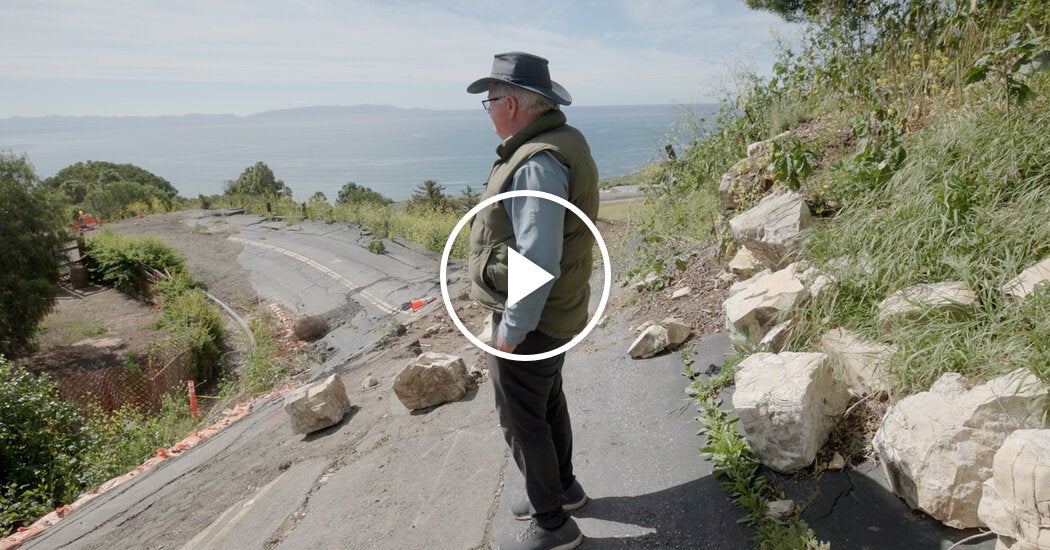
“Okay, don't step into the actual crack. You don't actually know how deep the crack is.” In 2024, Eilen Stewart bought a house on top of a landslide. “Honestly, our house prices are pretty low in Los Angeles. So when I saw this house in this great neighborhood, it's safe. It's beautiful. The school district is great. So I was like, this house is half the price it should be. Of course, that's when I realized there's a reason this house is the price it is.” Back then, the land here was moving a foot a week. But the house seemed OK, so Eilen and her husband settled on the $1.3 million contract in coastal Palos Verdes, California. “We knew there would be landslides, but we made calculated risks. And we'll see if it pays off.” Parts of Palos Verdes have been inching toward the sea for decades, but heavy rains in recent years have accelerated landslides, cracking foundations and destroying homes. “This is probably one of the largest active residential landslides in the entire United States, if not the world. It's like a giant raft moving deep down on this real slippery geological formation.” “For longtime residents like Tim Kelly, who bought a home here in 1994, eviction means a big financial blow. Landslides are generally not covered by insurance. So before the landslide, my house was valued at about $2.1 million, based on Zillow, Redfin, etc. It was revalued on the LA County tax rolls at $129,000. Alright, guys. 7:01, we're late.'' With little choice but to stay put, Tim and a team of dedicated neighbors try to slow the landslide by drying it out. Every morning, they turn on the well's generator to pump water from the ground. “Installing dewatering wells is one of the key approaches to slowing landslides, and as a result of taking these steps, we've seen a dramatic reduction in migration. In some areas, we've reduced migration by almost 90 percent at peak times.” Last winter's wetter rain than previous years was also a factor. In 2024, gas and electricity were cut off in many areas, leaving residents without power. Some families have left their homes completely for safety reasons. Almost two years later, 172 homes, including Eilen's, remain off the grid. Her land has also moved a lot since she moved. “When we first moved in, we probably saw this much water. It was kind of small and long. But all the houses in front of us sank about 10 feet. And part of the silver lining is that the visibility is much better.” Eilen estimates he spent about $200,000 in landslide-related repairs, including picking up the house, putting it on a steel frame and moving it away from the landslide. But all this may just be delaying the inevitable. “You're at war with nature. What we're seeing is that nature is changing with climate change and perhaps more rainfall in the future. We have the tools and methods to tackle it, but it's just very expensive.” As of June of this year, the city of Palos Verdes will have spent about $65 million on landslide mitigation starting in 2022. The city's overall annual budget is approximately $40 million. “We're actively trying to get funding from the state and federal government so that we can solve the problem and implement the solutions that we have. But we need more to continue.”At least 11 homes have been sold in the landslide area since 2024. Last summer, the city banned future new construction on the site. However, anyone can move in freely. But if they want, that's their choice. ” “What would you do if your house slid down the hill tomorrow?'' “I still lived here, pitching a tent in that backyard.''
Trending
- Welcome to the neighborhood. It's thinking.
- Where Israeli attacks are hitting Beirut
- How will President Trump's election lies affect the 2026 midterm elections?
- How we analyzed the Iranian school strike
- How Alberto Carvalho became LAUSD coach despite scandal
- How the Iran war is disrupting global oil
- How Jeffrey Epstein used doctors to control women
- How did President Trump decide to go to war?
