



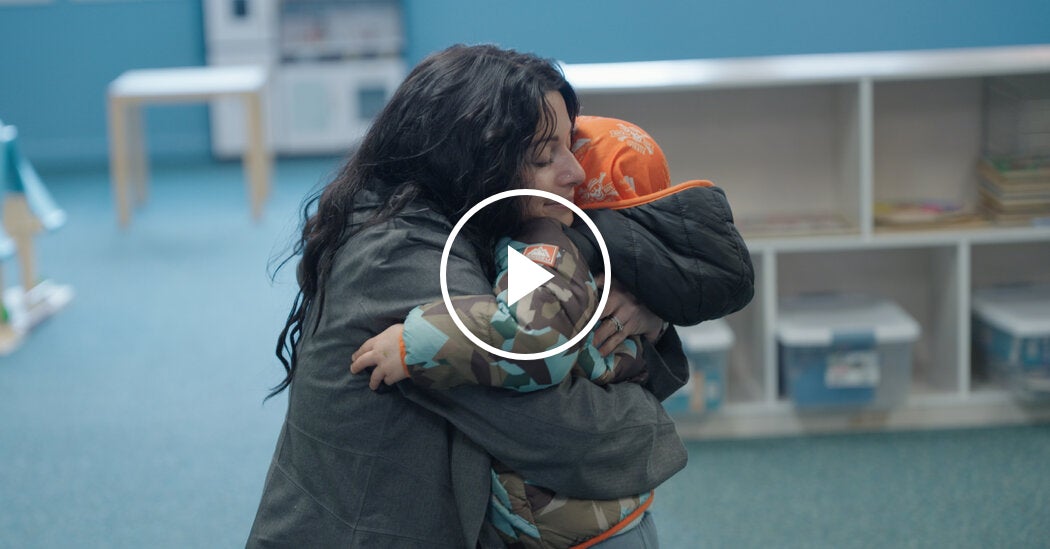
Vermont had a problem. Childcare fees were too high. “You're paying $3,500 a month, which is more than double your mortgage.” Some parents gave up their careers to stay home — “Once daycare is over, you're probably going to get an extra $60 a week to go home. At that point, it's not even worth it.” It's becoming harder for local businesses to hire workers. Some companies wanted the state to pay for childcare, but they faced major obstacles. “The word tax. It's a very volatile word.” Ultimately, Vermont succeeded in making child care more affordable. So we came here to find out how they do it. Affordability issues could be a focus of this year's midterm elections. “Affordable.” “Affordable.” “Affordable.” “Affordability Crisis” A recent Times-Siena poll found that 44 percent of voters said it was not economical to start a family. For example, Alison Barnes and her husband wanted a third child. “It felt like our family wasn't complete.'' But child care for the two children there costs $3,500 a month, and Alison's mother had already poured into retirement savings to help pay for it. “There's no way to make that happen.'' For years, Vermont's working-age population has been declining, leaving businesses like Smuggler's Notch Resort to compete to find the workers they need. In 2022, resorts were short of 12 or more housekeepers. The managing director was fed up with being understaffed and decided to try something new. He provided free child care to his employees. “We announced the new program on Friday, and by Tuesday it was full. All the jobs were filled, so we knew we were really on to something.” Child care benefits attracted employees like Becca Bishop, who wanted to return to the workforce after several years as a stay-at-home mom. “I decided to start working here purely because of the childcare facilities.” Now, before work, she drops her 3-year-old son, Archer, at the on-site daycare center and her 5-year-old son, Hunter, at ski camp. Ski camp is also free. She has since worked full-time managing the resort's arcade. Once Bill solved his staffing problems, he began talking to other CEOs in Vermont about the benefits of child care and began lobbying for a new tax to fund it statewide. “When I first moved back to Vermont and worked for the governor, I was talking to all kinds of Vermonters, and I found that everything they cared about was actually tied to child care. Allie Richards spent 10 years expanding child care in Vermont, and she said business leaders like Bill played a key role in that push.” Did she give lawmakers the green light to move forward on this issue? A lot of times, businesses come into this building and say, “No more taxes.” In this case, it really flipped. They have become the most powerful voice in advocating for public investment. ” “What we really need to do is try it and see what happens.” The child care bill, Act No. 76, was passed in 2023. A new 0.44% payroll tax on employers generates approximately $125 million annually to fund child care subsidies. Families pay on a sliding scale. In other words, a family of four with a moderate income would not have to pay childcare fees. High-income households are expected to keep their out-of-pocket costs to around 10% or less of their income. It's only been a year since the law was fully implemented, but the new funding has already secured more than 1,200 new child care slots for children across Vermont. For years, daycare centers remained closed because they could not cover the costs of childcare. Now, new stores are opening, like this one in the agricultural town of Addison. Michelle Bishop dreamed of starting a place like this, but couldn't afford to open until she could count on the state to pay her more than $400 per child per week. “We have 16 children enrolled, 80% of whom are on subsidies.” The additional funding also meant that they could actually afford to pay their employees a living wage. More child care facilities are needed to fully meet demand across Vermont. But for now, the difference the new law has made for Vermonters is clear. Alison and her husband were finally able to have the third child they wanted, knowing their child support would be about $30,000 less per year than they would have been without the new law. “I can't imagine our family without that third child. It's literally life-changing. It's like – she wouldn't be here.” For Rebecca, free childcare means she can save up to buy a new home that's suitable for her family. “Yes, we're going to stay in Vermont.” Michelle plans to expand the toddler room this spring. “We'd like to open in March or April. We're almost done.” And as for the building, he says the new taxes are nothing compared to what Vermont gets. “We didn't levy new taxes and find out we can't pay the bill. We're still here.” “In Vermont, we're really coming together and doing well.”
Trending
- Unraveling the mystery behind Bitcoin's creator
- Skilled foreign workers consider leaving the US
- Cape Town's housing crisis – New York Times
- Connections between the Supreme Court and immigration
- Unraveling the world's newest and deadliest drugs
- Five lessons learned from the “No Kings” rally as midterm elections heat up
- Big names in fine dining now host rock stars
- Energy crisis forces Indian restaurants to adapt
