



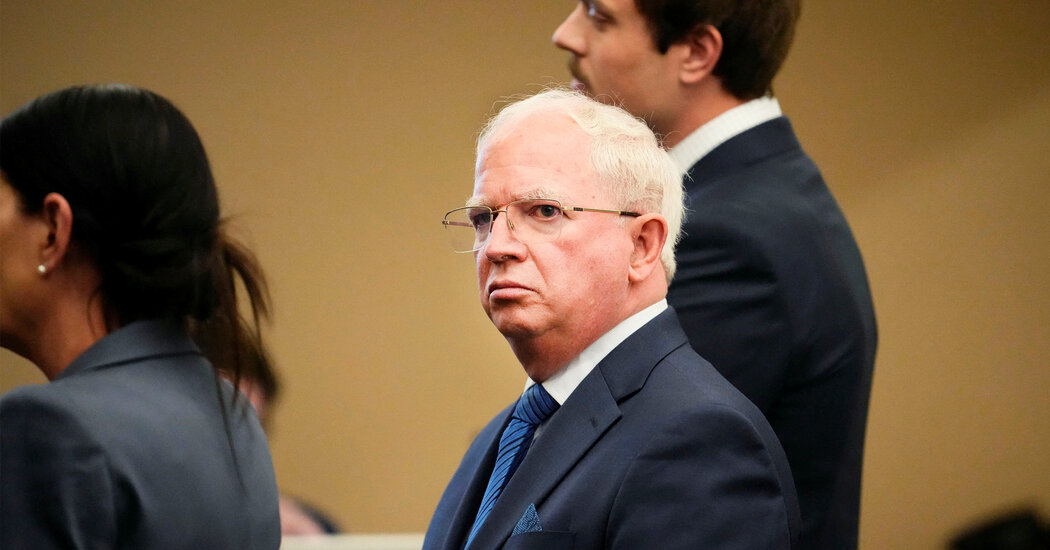
Aides of former President Donald J. Trump, who has been charged in a wide-ranging election lawsuit in Arizona, began filing a series of lawsuits Friday that are expected to exploit a new state law aimed at curbing lawsuits and prosecutions involving politicians.
The law was originally written by Corey Langhofer, a Phoenix lawyer who worked with the Trump campaign during the 2020 election and has since fallen out of favor with the former president. He said the purpose of the 2022 law is to limit politically motivated prosecutions by both the ruling and opposition parties.
Given the timeline for rulings and appeals, the new challenges could result in several months of delays to Arizona's election lawsuit, which was filed in April by Democratic state Attorney General Chris Mays.
The 18 defendants are each charged with nine counts of fraud, forgery and conspiracy. The indictment lists a range of efforts the defendants made to overturn Arizona's election results, from a scheme to cast fake electors for Trump even though he lost the vote, to steps some of them took to pressure “officials responsible for certifying the election results.”
Those indicted include seven advisers to Trump, including his former personal lawyer, Rudolph W. Giuliani, and former White House chief of staff, Mark Meadows. Eleven Republicans were also indicted for supporting Trump and claiming to be Arizona's electors, even though President Biden had already been certified as the winner.
The bill, passed by the Republican-controlled Legislature and signed by then-Republican Gov. Doug Ducey, was an expansion of legislation mimicking statutes in many other states aimed at thwarting a legal tactic known as “strategic litigation against public participation.”
These so-called “anti-SLAPP” laws are intended to prevent corporations and government officials from filing frivolous defamation lawsuits against private citizens who disagree with them.
However, Arizona expanded the law in 2022 to apply it more broadly to cases such as challenges to criminal charges.
The new lawsuit argues that the government's cases against Trump allies amount to SLAPP lawsuits and should be dismissed.
The first motion to use the law was filed Friday by attorney John Eastman, one of the architects of the plot to place fake electors in battleground states.
“Arizona's 2022 Amendment Act expands the scope of state law to include criminal proceedings, but is clearly intended to prevent public officials from weaponizing criminal proceedings to punish or thwart speech on politically charged issues,” Eastman's attorney, Ashley Adams, wrote in the lawsuit.
She continued, “Public officials have a First Amendment right to express their differences through public forum, but they should not use indictments to silence their opponents, as the Attorney General has attempted to do here.”
Lawyers for the other 18 people charged in the case have said they plan to file numerous similar motions.
Arizona's law has already been applied in court: Kali Lake, the unsuccessful Republican gubernatorial candidate who falsely claimed election fraud, tried to use the strengthened anti-SLAPP law as a legal shield after being sued for defamation by the top elections official in Maricopa County, which includes Phoenix. Lake was unsuccessful and was later awarded a default judgment after she refused to defend the defamation suit.
In February, a man who was charged with disorderly conduct after an altercation at a mobile home park in Cottonwood, Arizona, used the new law to successfully get some of the charges dismissed.
Langhofer represented the Trump campaign after the 2020 election, but angered Trump by refusing to accept baseless claims of election fraud. In an interview, Langhofer said he authored the bill because he was disillusioned by the increasing hostility and danger faced by people in politics and considered moving abroad.
“I had a real fear that this trend of political prosecution would get out of control and that once it got going, it would be very hard to stop,” he said in an interview. “Once you get on that train, there are no stations to stop it at.”
Mr. Langhofer said he was persuaded by friends to craft legislation to address the problem, with anti-SLAPP legislation at its center. (Mr. Langhofer himself has had lawsuits ruled moot by courts, but he has contested the ruling.)
He took the proposal to Ben Toma, a conservative state representative from suburban Phoenix who was then the majority leader and is now Arizona Assembly speaker and a candidate for the House of Representatives. At the time, Toma said his bill was intended to “make sure that people who exercise their First Amendment rights can't be sued just for doing so.”
The law allows a person to challenge a lawsuit or indictment in court within 60 days of receiving notice of the proceeding, but in order to do so, they must allege that they are the victim of political retaliation.
Langhofer said the election prosecution is a good test case.
“This is the first case of its kind in Arizona, and I think it's a strong candidate for the remedies that the law contemplates,” he said. When it comes to election prosecutions, “two things can be true at the same time: the defendants have engaged in extremely egregious conduct and said things that are not true, and they are the victims of a politically motivated prosecution. Both of those things can be true, and that appears to be what's happening now.”
Attorney General Mays' office has not commented on the new allegations.
Arizona is one of five states to have filed criminal charges related to the Trump campaign's handling of the 2020 election. Special counsel appointed by the Justice Department, Jack Smith, is also bringing charges against Trump for alleged election interference.
A Nevada judge on Friday dismissed the state's lawsuit against six Republicans who acted as fake electors in the state, saying state prosecutors chose the wrong place to bring the case. Nevada Attorney General Aaron D. Ford's office announced it would appeal.
Many other states have anti-SLAPP laws, but they apply to civil lawsuits. The bill passed in Arizona in 2022 and received relatively little attention when it was passed. Some First Amendment advocates in the state, who have spent years urging Arizona lawmakers to pass stronger protections against retaliation for free speech, said the law caught them off guard.
Greg Leslie, executive director of the First Amendment Clinic at Arizona State University, said the law “really came out of nowhere” and that press freedom groups like his weren't consulted.
Arizona Democrats said the bill initially had bipartisan support because some Democrats thought it could protect anti-police protesters from retaliatory arrests in the wake of the crackdown on Black Lives Matter protesters. But as the bill made its way through the state Legislature and amendments were introduced, they began to express some concern about the need for the bill, and ultimately most voted against it.
“It's very suspicious,” said Martin Quesada, a former Democratic state senator who voted against the bill. “It's a complex issue, and not many people understood what it was trying to accomplish. People had a lot of mental energy devoted to other bigger issues. And so it got through.”
Lawmakers said at the time the anti-SLAPP bill seemed almost an afterthought compared to the centrist political battle over Republican proposals that would have overhauled Arizona's voting system, mandating manual ballot counting, imposing stricter voter ID requirements or giving the Legislature the power to reject election results. When the bill came up for a final vote, it passed without a single lawmaker speaking for or against it.
“At that time, there were hundreds of bills being introduced in the Legislature,” said Domingo DeGrazia, a former Democratic state Assemblyman who voted against the bill after questioning its necessity during a House committee hearing. “It was a classic bill rush.”
