



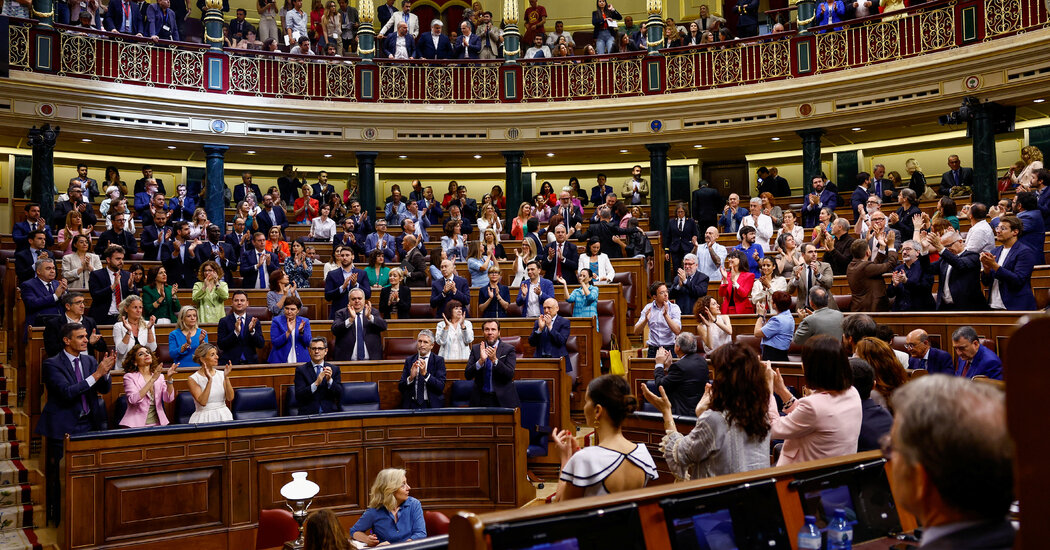
The Spanish parliament on Thursday approved landmark legislation granting amnesty to Catalan separatists involved in October 2017's illegal independence referendum. The amnesty could apply to hundreds of people, including former Catalan president Carles Puigdemont, who has been living in self-imposed exile for seven years.
The move has been resisted by opposition parties in recent months, sparking anger and large-scale demonstrations in cities across Spain, who denounce it as a ploy to maintain power for Prime Minister Pedro Sanchez, who brokered the amnesty deal with Catalan separatist group Unite for Catalonia after his party fell short of a majority in last July's general election.
As Sanchez cast his vote Thursday, cries of “traitor” were heard from several lawmakers in Congress.
Spanish judges have two months to apply the new law, but opponents have vowed to continue blocking it, with some arguing that the measure violates the constitution's principle of equality because it is unfair to others facing legal action.
Madrid Governor Isabel Ayuso said in a radio interview on Thursday that the government would take steps to block the new law from going into effect and would appeal it as unconstitutional.
Pablo Simon, a political scientist at Madrid's Carlos III University, said legal action could also be brought if judges determined that granting a general legal amnesty was discriminatory.
“Different judges have different standards,” Simon said, adding that the European Court of Justice could be asked to intervene “if they decide that granting a general legal amnesty would be discriminatory”. That could “paralyze the law”, he said.
The amnesty law applies to people linked to the Catalan independence movement, which culminated in October 2017 when Puigdemont's separatist government defied a Spanish court order and forced through a referendum.
Police violence left many voters injured, and independence was declared after the vote. Repression by the Spanish government continued, dissolving the Catalan government and imposing direct control. Nine political leaders were jailed on sedition charges and Puigdemont fled across the border into France and then Belgium, narrowly avoiding arrest.
The Sánchez administration has already granted pardons to jailed political leaders and activists, but the amnesty takes it a step further: It dismisses cases against people facing indictment on a wide range of charges, including the misuse of public funds to finance a 2017 referendum, civil disobedience by teachers who opened their schools as polling stations, and resisting authority by taking part in riots that prevented Spanish law enforcement from collecting evidence.
The only exception to the new amnesty law is for terrorism-related cases.
