



The police station in Hienghene, a remote town in New Caledonia in the Pacific Ocean, has remained sealed off for nearly three weeks. Dozens of protesters have blocked the access road to the station and taken turns standing guard from outside. Their purpose is clear from words scrawled in chalk on the road: the names of three prominent French politicians, including the president, and the word “assassin.”
The standoff is one example of the current fragile standoff in New Caledonia, where protests against more than 170 years of French rule turned violent last month, pushing the territory to the brink of civil war, leaving seven people dead, many more injured and causing businesses to suffer hundreds of millions of dollars worth of losses.
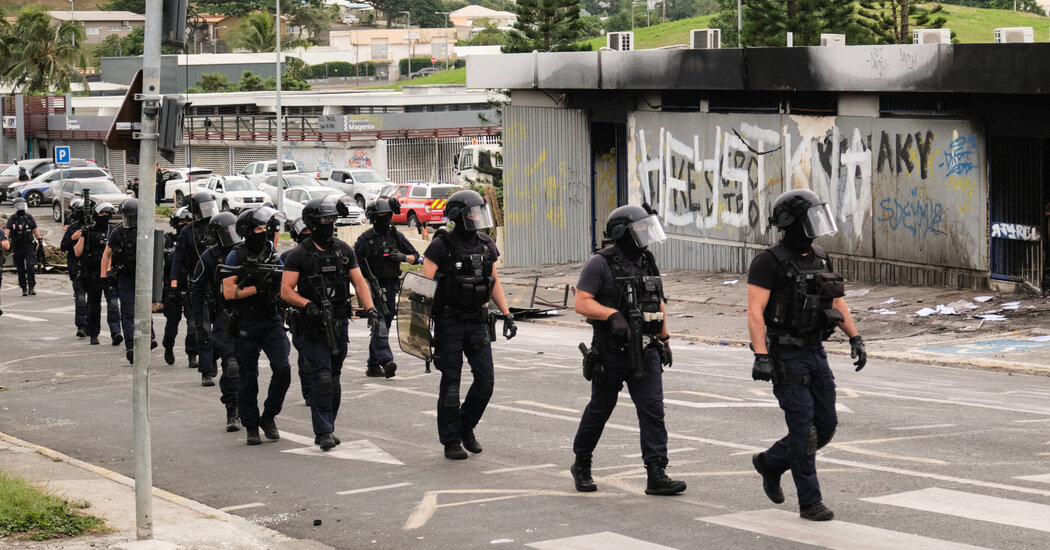
France has rushed thousands of armed police into the semi-autonomous region to quell the worst of the violence, including a surprise visit from President Emmanuel Macron, who declared a state of emergency for several days, banned TikTok and closed the region's main airport. Those restrictions have since been lifted and commercial flights have gradually resumed from a small runway near the capital, Noumea, but the region's main airport remains closed.
Authorities have maintained a night-time curfew and a ban on alcohol sales, and indigenous Kanak protesters have maintained barricades outside Nouméa and in remote towns like Hienghene.
“We close the door on them, lock them there, show them what it's like for a Kanak boy to be locked up in a Noumea prison,” Jonas Thein, a protester in Yongehen, said of the town's police station, which appears to be regularly visited and resupplied by a police helicopter. “We are trying to keep calm,” he said, but the French police crackdown “makes me want to take my gun and do what they did in Noumea.”
Tensions over French rule have been simmering in New Caledonia since the country's civil war in the 1980s. The current unrest stems from President Macron's proposal to add thousands of French immigrants to New Caledonia's electoral rolls. Macron called the change a step toward full democracy in the region. But to many Kanaks, it was a betrayal of decades-old peace agreements. They also worry that the influx of new voters will make it impossible for them to win independence in a future referendum.
New Caledonia and its vast nickel deposits have added strategic value to France in a Pacific region where China is gaining influence, and French supporters say an independent New Caledonia could easily lean towards Beijing.
Macron announced he was postponing the voter roll proposal during a visit to New Caledonia, and Kanak leaders and moderate French supporters have since called on him to withdraw the proposal altogether.
“The only way to calm the situation is to remove the text of the constitutional amendment,” said Joel Tibau, who is leading the siege of the Hienghene police station. Tibau's father was a prominent Kanak leader who was assassinated after negotiating an end to the region's civil war in the 1980s.
Politicians from the region's pro-independence and loyalist parties are now working with a high-level French delegation to find a compromise that could resolve tensions, but participants warn that progress will be slow.
“The state has the power of surveillance, but we have time,” Roche Oumitan, the pro-independence speaker of New Caledonia's parliament, told local media.
Independence leaders have called for an end to the violence, but the unrest has left some of New Caledonia's white residents worried about their future. Mining has brought prosperity to the country, but there is a stark economic disparity between whites and the Kanak people, who are now a minority in their homeland.
Nicolas Segnac, who lives in Koumac, a community north of Nouméa, said that while protests have not turned violent in his town, fuel supplies have been cut off and food has become hard to come by. He said he feels “held hostage” and “abandoned” by the French government.
“The last few weeks have made it clear that there is no future for France in New Caledonia unless France comes to some kind of agreement with the aspirations of the independence movement,” said Adrian Mackle, a history professor at Victoria University of Wellington in New Zealand. “It really highlights the power that the independence movement has to economically stagnate New Caledonia.”
Most of the unrest has been centered around Nouméa in southern New Caledonia. French authorities are investigating several incidents in the past few weeks, including several gunshots by unknown assailants against Kanak protesters, French police officers who were seen on video forcing a Kanak protester to his knees, with one officer kicking the man in the head, and a police officer of Kanak descent reportedly being severely beaten by local French militia.
Two police officers have been killed by protesters. French authorities say a further 192 people were injured. Police officials say protesters planted gas tanks in some of the barricades. One police officer was injured after falling into a manhole that protesters had converted into a booby trap. There have been further reports of shootings this week.
A spokesman for Louis Le Franc, the top French government official in New Caledonia, declined to comment.
The death toll from the current violence is far lower than during New Caledonia's civil war, but “the scale of the damage inflicted on Noumea is much greater,” Dr. Makul said. “It's really shocking for many people in New Caledonia to see what can be done in such a short time. There are many people who are thinking seriously about the future of New Caledonia.”
Lizzy Carboni, a writer who lives in Nouméa, is one of them. Armed police are stationed in her neighbourhood, and on Friday protesters walked through her street, threatening to set fire to residents' homes. “I feel safe during the day,” Carboni said. “But at night, they might throw stones at my window.”
Carboni is now in the process of leaving New Caledonia, and last week she took part in an online seminar about moving to New Zealand, attended by more than 100 people, most of whom appeared to be New Caledonians.
“Looking at how quickly this chaos has happened, I don't know what tomorrow will bring,” she said. “I'm not confident anymore.”
