



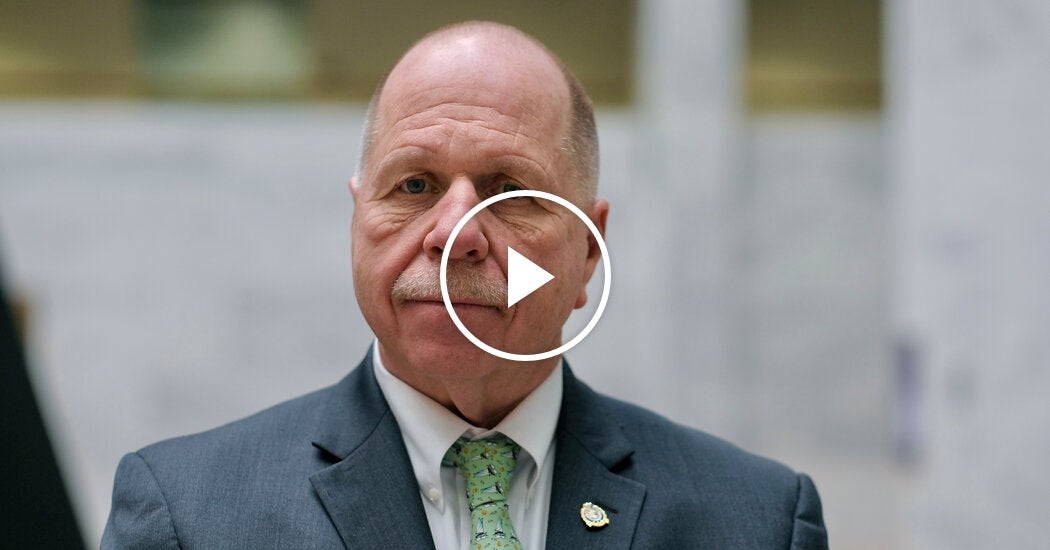
On January 21, ICE agents in Portland, Maine, arrested Emanuel Landilla, an asylum seeker from Angola who was legally working as a corrections officer recruit. “Hello.” Hours later, Cumberland County Sheriff Kevin Joyce publicly defended the officers-in-training he vetted and hired a year ago. “In fact, he was squeaky clean. Squeaky clean.” Sheriff Joyce then offered his most scathing criticism of local police's ICE tactics. “Within three minutes, they got out of the car, pulled him out of the car, handcuffed him and put him in the car. They all took off and left his car with the windows down, lights on, unsecured and empty. Folks, that's bush league police.” “I knew this man was not a criminal.'' We spoke with Joyce in Washington, D.C., days after he criticized ICE's operations in Maine. He was at the annual conference of the National Sheriff's Association. – “How are you?” – “Hello, Kevin Joyce.” And to share his concerns with members of Congress. “They came at him like stormtroopers. It's a tactic. I called them the Bush League because that's what it is. It's not professionalism, but it's hitting quotas. And you can't put quotas on law enforcement, because bad things happen.” To carry out mass deportations, ICE needs the cooperation of local law enforcement, primarily in the form of access to local jails. But relations soured after sending thousands of masked ICE and Border Patrol agents into American cities. The rally in Washington, D.C., drew hundreds of sheriffs from across the country for training and meetings. “We still haven't stopped a million pounds of cocaine, the equivalent of 24 or 42 dump trucks,” and will meet with government officials. Many called for better communication and more respect from ICE. “Communication is the worst of the worst. We can still work together, but it takes cooperation. It's just impossible to come to our city and cast a shadow on us and expect us to respond to you.” “It creates a divide within my own profession. There's a right way to do our job, and there's a wrong way. So what you're seeing is this kind of enforcement that isn't making us safer. It's dividing us.” Whether and how police cooperate with immigration enforcement has long been a topic of debate, but especially now. “Give us access to illegal alien public safety threats within the safety and security of our prisons. Put these agreements in place, which means fewer officers on the streets.” Over the past year, more than 1,000 law enforcement agencies have signed partnership agreements with ICE. Many are holding prison inmates so they can be picked up by ICE. “They're already in custody, so they don't have to go out and make an arrest on the scene. They just come to our jail, pick us up, and take us away.” More states are banning or restricting some police departments from working with ICE. Other states have done the opposite and are now asking police to cooperate with ICE. “Personally, I like it. We get rid of them. If we get rid of people who don't need to be here, that's great.'' “What's the longest time ICE has held someone in your jail?'' “I'd say it was 100 days one time.'' Many sheriffs rent out jail space for ICE detention as a way to generate income. “They paid $150 per prisoner per day.” “So how much does that cost in a year?” “Approximately $3 million. For 33 years, we have held ICE inmates in the Cumberland County Jail. Two hours after my press conference, they withdrew 50 inmates.” In a statement to the Times, a DHS spokesperson said ICE withdrew detainees from the Cumberland County Jail over the employment of illegal aliens and issued a subpoena to the sheriff's office for employment records. Mr Joyce said he had properly vetted Mr Randira. After three weeks in custody, a federal judge ordered Randila released on bond. Sheriff Joyce is evaluating whether his office can still hire him. “I just wanted to take a moment to stop by and thank you for your efforts in response to the increase in immigration issues that have occurred over the past few weeks.'' After the meeting, Sheriff Joyce met with Maine lawmakers at the Capitol, where Democrats are threatening to block funding to DHS unless immigration agents are held to higher police standards. “So one of the reasons we support the Homeland Security bill is to talk about adding these kinds of standards that we expect from our police officers: not wearing masks, requiring body cameras, getting an actual judicial warrant before breaking down your door or taking you somewhere. So these are things that people have come to expect from law enforcement, and they're important to the public's ability to trust law enforcement.” “We have to go back to each city with the message that things will be better by the summer. If we don't, we're going to have a long summer. What I'm concerned about is law enforcement fighting with the federal government.”
Trending
- Five lessons learned from the “No Kings” rally as midterm elections heat up
- Big names in fine dining now host rock stars
- Energy crisis forces Indian restaurants to adapt
- How Kharg Island could change the trajectory of the Iran war
- 34 ex-military personnel have been subject to deportation in the past year
- Take a look at the Times' takeaways from inside the CDC
- How the Supreme Court will change voting by mail
- Public references to Cesar Chavez removed across the US
