



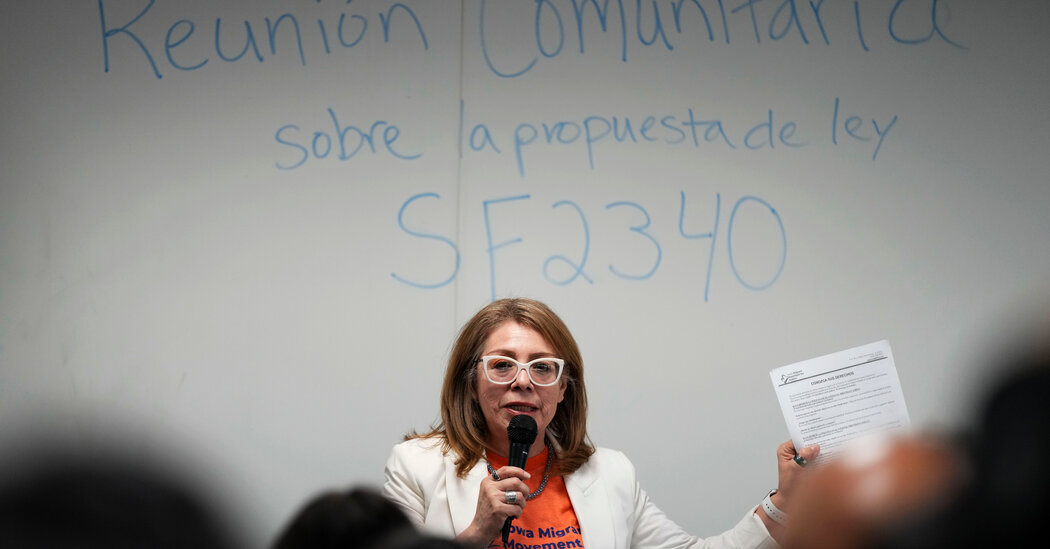
A federal judge on Monday temporarily blocked Iowa from enforcing its own immigration law, which makes it a state crime to enter Iowa after being deported or refused entry from the United States.
The ruling comes amid a nationwide push by conservatives in state legislatures to assert authority over illegal immigration, which the Justice Department argues is solely the federal government's responsibility.
“As a political matter, the new law may be defensible,” Judge Steven Locker wrote. “As a constitutional matter, it is not.”
Iowa was one of the few Republican-led states to enact state-level immigration enforcement this year, infuriating Biden administration officials who say the laws are unconstitutional overreach. Iowa officials have vowed to appeal the judge's order granting the temporary restraining order.
“I am disappointed with today's court decision that prevents Iowa from preventing illegal re-entry and keeping our communities safe,” state Attorney General Brenna Byrd, a Republican, said in a statement. “Because Biden has refused to secure our border, states have no choice but to do the job for him.”
Immigration has become a central issue in this year's presidential election, and federal officials have seen a surge in migrants crossing the US-Mexico border. States with Republican governors, including Iowa, have also sent National Guard troops to Texas to help with border security.
“Clearly the Biden Administration is failing to enforce federal immigration law, allowing millions of people to enter and reenter the U.S. without penalty or delay,” Iowa Gov. Kim Reynolds, a Republican, said in a statement Monday. “I signed this bill to protect Iowans and communities from the increased crime, drug overdose deaths and human trafficking that are the result of this border crisis.”
After Republican Reynolds signed the bill into law, the Justice Department filed a lawsuit, asking a federal judge to intervene before the bill takes effect on July 1.
“Iowa cannot ignore the U.S. Constitution and the Supreme Court's established precedents,” Brian M. Boynton, the Department of Justice's civil division chief, said in a statement when the lawsuit was filed. “We filed this lawsuit to ensure that Iowa complies with the framework adopted by Congress and the Constitution regarding immigration regulation.”
Judge Locher, an appointee of President Biden, said challengers of the law are likely to prevail on the merits and listed specific concerns about how Iowa lawmakers envision the law being implemented.
“Senate File 2340 exacerbates the conflict preemption problem by forcing Iowa judges to issue orders requiring aliens to return to their countries of origin,” Judge Locher of the U.S. District Court for the Southern District of Iowa wrote. “Congress established a complex, specialized system involving multiple layers of review by trained immigration officials and judges to determine when deportation can occur and where people must go.”
Efforts by conservative states to take a role in immigration enforcement, and the Biden administration's resistance to those efforts, have exposed continuing tensions in the balance of power between the federal and state governments, and the legality of state immigration laws may ultimately be decided by the U.S. Supreme Court.
Federal courts this year temporarily blocked enforcement of a Texas law that allows police to arrest and deport immigrants, and parts of a Florida law that makes it a crime to transport someone into the state without legal immigration status. The Justice Department is also suing Oklahoma over a law passed that makes it a state crime for an alien not in the U.S. legally to be in the state.
