



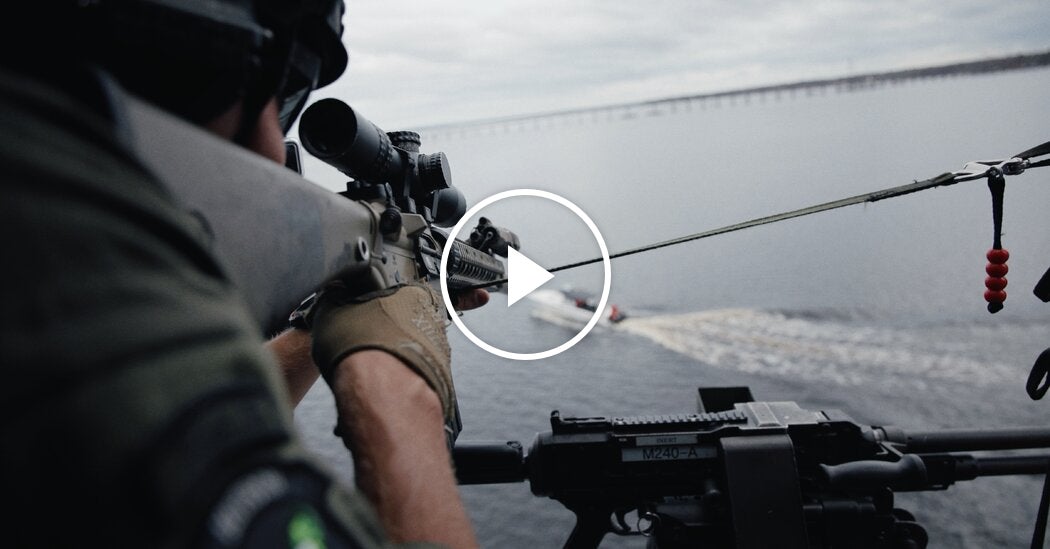
We're flying with the Coast Guard's Helicopter Interdiction Tactical Squadron (HITRON), which chases speedboats imitating drug traffickers at sea, just outside Jacksonville, Florida. They are drug enforcement police on the high seas. They seize suspicious ships, seize illegal drugs, and arrest suspected drug smugglers to bring them to justice. The gunner aims at the engine. “We will not intentionally fire to injure, kill or injure anyone. Our primary target will be the engine.” They are now practicing a common tactic of smugglers: using the body to protect the motor from gunfire. They do this because they know the Coast Guard will do everything possible to avoid casualties. “And you are very careful not to attack anyone on board a boat with suspected drugs.'' “Correct.'' “Why?'' “I just joined the life-saving service, that's all, really.'' To justify the operation, the Pentagon identifies drug smugglers as illegal combatants, attacking the same type of speedboats that the Coast Guard targets. But legal experts say the attack violates U.S. and international law. We spent two days with HITRON and its tactical forces in Miami, observing how they rely on non-lethal tactics to intercept and seize drug ships long before the military intervenes. Over the past several months, the Coast Guard has focused on counter-narcotics operations in the Eastern Pacific. More than 70 percent of U.S.-bound cocaine is trafficked through here to Mexico. “We officially classify fentanyl as a weapon of mass destruction.” President Trump cited fentanyl deaths to justify the deadly boat attack. However, the targeted boat was allegedly carrying cocaine, not fentanyl. In early December, the Coast Guard seized a boat carrying 20,000 pounds of cocaine, the largest ever. Two days later, U.S. forces raided a suspected drug boat in the same waters, killing all on board. I asked the Coast Guard about its mission and legal procedures to stop boats, seize drugs, and collect evidence that can be used to prosecute smugglers in court. “That's the nature of law enforcement. No law enforcement officer ever gets into a scenario where they're going to override their restraint.” And they had a record-breaking year. The Coast Guard seized approximately $4 billion worth of drugs, about four times the annual average, and detained 279 suspected drug traffickers. In the lounge above the hangar, Captain Broadhurst shows us a video of the techniques his squad has honed over 30 years at sea. “Has anyone ever successfully evaded a Hitron unit?'' “Once you're on a ship, the success rate is 97 percent. I'd say it's very, very low.'' Broadhurst said smugglers also understand the Coast Guard's limitations and adapt accordingly. He showed me videos of suspected smugglers trying to thwart the coast guard by not only throwing themselves into the engines, but also jumping into the sea knowingly changing their strategy. “So at this point, we cease law enforcement and go into search and rescue mode. It's a military service on the cutting edge of what we're doing for the government, and it's also a life-saving operation, so there's just a practical and humanitarian reason why we have to get that person out of the water.” In October, President Trump said the Coast Guard's interdiction was a failure when justifying the ship attack. “We've been doing that for 30 years and it hasn't worked at all.” “What's your answer to that?” “The president certainly understands that we patrol an area twice the size of the United States with fewer than 12 patrol cars, so he understands that if we have more operational resources, we can operate more efficiently.” In Miami, he encountered a Coast Guard tactical team boarding the smuggler after a helicopter unit neutralized it. “So, here's your scenario: We have a ship that is tasked with getting pos-con and working with other teams.” We saw them training to board larger ships, like container ships and oil tankers. They first infiltrate the ship and immediately capture the crew. On the next floor, they are confronted by armed smugglers. They only fire in self-defense, as they are trained to do. This scenario could become more likely as the United States escalates tensions with Venezuelan President Nicolas Maduro. In mid-December, President Trump declared a blockade of sanctioned oil tankers traveling in and out of Venezuela. Since then, specialized coast guard teams operating off the coast of Venezuela have boarded and seized at least two oil tankers. The Coast Guard has unique authority to board stateless and illegal vessels at sea and continues to play an important role in enforcing blockades.
Trending
- Unraveling the mystery behind Bitcoin's creator
- Skilled foreign workers consider leaving the US
- Cape Town's housing crisis – New York Times
- Connections between the Supreme Court and immigration
- Unraveling the world's newest and deadliest drugs
- Five lessons learned from the “No Kings” rally as midterm elections heat up
- Big names in fine dining now host rock stars
- Energy crisis forces Indian restaurants to adapt
