



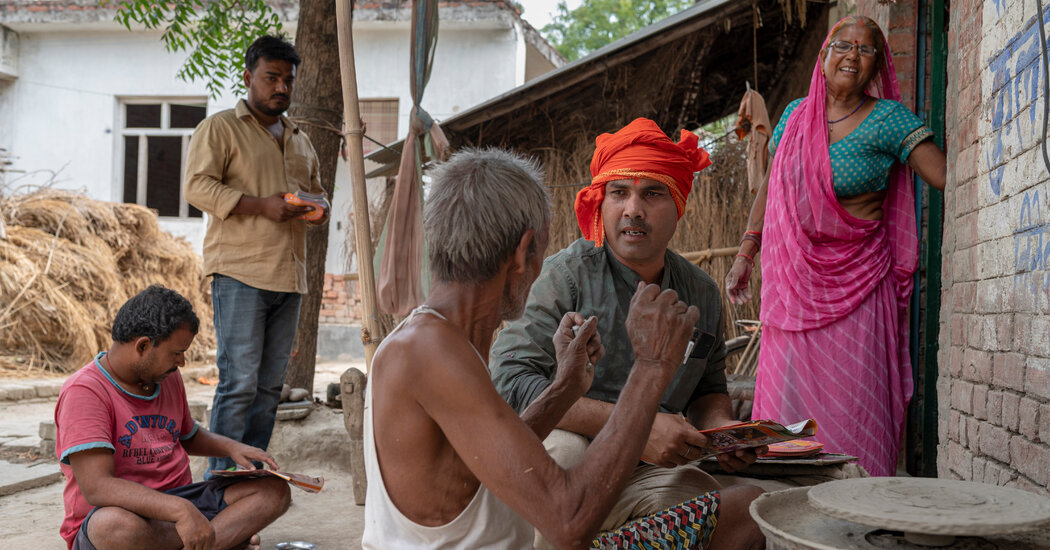
Durga Prasad, an 80-year-old farmer, was resting in the shade outside his house when party workers arrived. The app on their smartphones instantly told them who he was, who he was likely to vote for and why they should be grateful to Indian Prime Minister Narendra Modi.
“You're going to get it in 2,000-rupee instalments, right?” asked a local leader of Modi's Bharatiya Janata Party (BJP). Prasad agreed, saying he receives $72 a year through a farmer welfare program launched and branded by Modi.
“Can we get rations?” the official asked, but he already knew the answer: he was stating his opinion.
Such handouts are some of the most striking aspects of Mr. Modi's populist appeal. The country's new airports, diplomatic prestige and booming stock market may seem like Mr. Modi's trademarks, but the small infusions of cash and household goods mean more to the 95% of Indians who don't earn enough to file income tax. And Mr. Modi's party is organized to make the most of them in a general election that ends early next month.
India's welfare programs range widely in scope and scale. Under the largest program, 821 million Indians are entitled to receive 5 kilograms (11 pounds) of rice or wheat per month for free. The government began distributing the grains to prevent hunger early in the pandemic and has since spent $142 billion on the program. In January, Prime Minister Modi's face began to be painted on the bags.
Another prime ministerial program has helped build 15 million homes since 2015 at a cost of $3 billion a year, including renovations and expansions. The government is also paying for millions of toilets and working to provide running water to every household.
The groundwork for this expanded welfare package was laid shortly after Modi became prime minister in 2014. Linked to a universal ID program launched by the previous government, “PM”-branded bank accounts were made available to all unbanked Indians.
These accounts have provided the government with valuable information about the economic health of its poorest citizens, and have paved the way for “direct transfers” that bypass the sometimes corrupt local officials who once handed out welfare payments, seemingly funded by Prime Minister Modi himself.
Those transfers grew to $76 billion last fiscal year. But Mr. Modi's budget has not been extravagant, in part because government spending on education and health — long-term investments — has shrunk as a share of the economy while branded welfare programs have proliferated. Spending on a job guarantee program linked to Mr. Modi's opponents has also fallen.
Whatever the motivation, the tangible food and household transfers that Modi prioritized have eased the pain for Indians as the economy slowed before the pandemic, collapsed in the first year, and then recovered unevenly. His Hindu nationalist government has distributed the aid equally to all religious groups, even if it hasn't won many votes from some of them.
These handouts are the strongest thing Modi can claim to have improved the lives of hundreds of millions of Indians desperate for stable, decent-paying jobs.
“Our party is specifically working on programmes that will affect everyone,” said Vinod Misra, a local BJP leader who visited Prasad recently in Amethi district, Uttar Pradesh, an impoverished area where people once died of hunger.
“All we have to do is go to the family and say, 'Brother, who built this roof?'” Misra said.
In a country where 80% of the population is rural or poor, people are very serious about getting something in exchange for their vote, said Pradeep Gupta, director of polling agency Axis My India. If a politician delivers on his promises, “people will choose him again and again,” Mr. Gupta said. Everything else is “marketing.”
The BJP’s follow-up with voters is the end result of a massive effort that leverages an ideologically loyal core of members, funding, a country-wide organisation and increasingly sophisticated data management.
In Pushkar, a temple town west of Amethi in the BJP's Hindi-speaking “cowbelt,” another local party worker explained the benefits of the app, Saral. With a few swipes and taps, Shakti Singh Rathore shared a bird's-eye view of the neighborhood he hopes to rally for Mr. Modi.
Pushkar's constituency has 241 “booths,” or polling stations, each with its own boundaries on a map. Rathore flipped open the information for one of the booths he oversees. His target was not just voters but beneficiaries, or “rabartis,” an important new term in ground campaigning.
“The names of all the Rabarti people are listed here,” Rathore said. He cited one man who had received a cooking gas cylinder, “and here's his address, postcode and phone number.” Another had received cash from a farmers' welfare programme.
“All the data is here,” Rathore said.
Anyone can download Saral from the Apple or Google Play store to stay up to date on election activities, but only registered BJP officials can view the database. The party's national leadership says it uses Saral to connect its more than six million employees, who can retrieve and upload data on voters and beneficiaries.
Voters do not seem confused, or at least surprised, by the sheer volume of information about their relationship to the national government being conveyed door-to-door by political activists.
Misra said he didn't know exactly how the personal information ended up on the app. Other local-level officials said the accuracy of the data led them to speculate it was likely provided by the government itself. BJP's information technology chief Amit Malviya said at a startups conference in December that the 30 terabytes of data had been collected manually by the party over the past 10 elections.
Salar also carries out many other activities that help the party's election campaign. It tracks the activities of its operatives and benchmarks them against each other on their performance, essentially “gamifying” the rigors of campaigning.
Workers will also have the opportunity to blur the lines between partisan politics and government work and help make it easier for constituents to get their benefits.
Modi himself told a television crew this month that he had instructed party workers to gather information about voters who had not received their benefits and “this is Prime Minister Modi's guarantee that they will get them in my third term.”
BJP activist Ajay Singh Gaur, who accompanied Misra on a door-to-door tour around Amethi, got caught up in a lengthy exchange with farmer Dinesh Maurya, who complained that a faulty electric cable had fallen into his wheat field.
“All my crops have been burnt and I have not received a single compensation,” Maurya said.
Gaur assured Maurya that he would repay the debt the state owes him. “I have spoken to the plant manager,” he said. “I will repay it.”
Mujib Mashal Contributed report.
